


The Slow Death of Hairdressing
Information is instant. Recognition can be instant. Mastery is still slow. What happens to a craft that demands years of frustration before it pays back, in a culture that has made slow progress feel like failure?
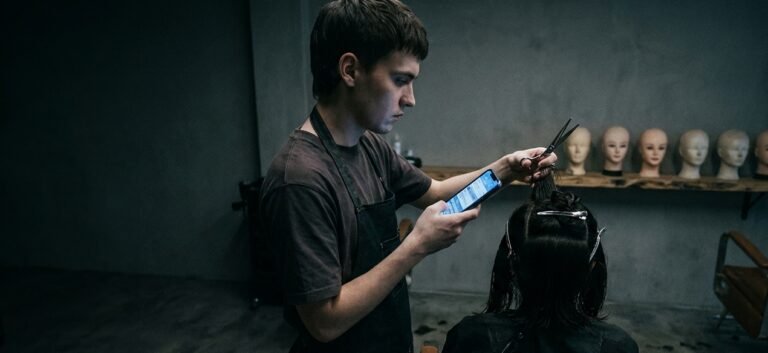
The video lasts thirty seconds.
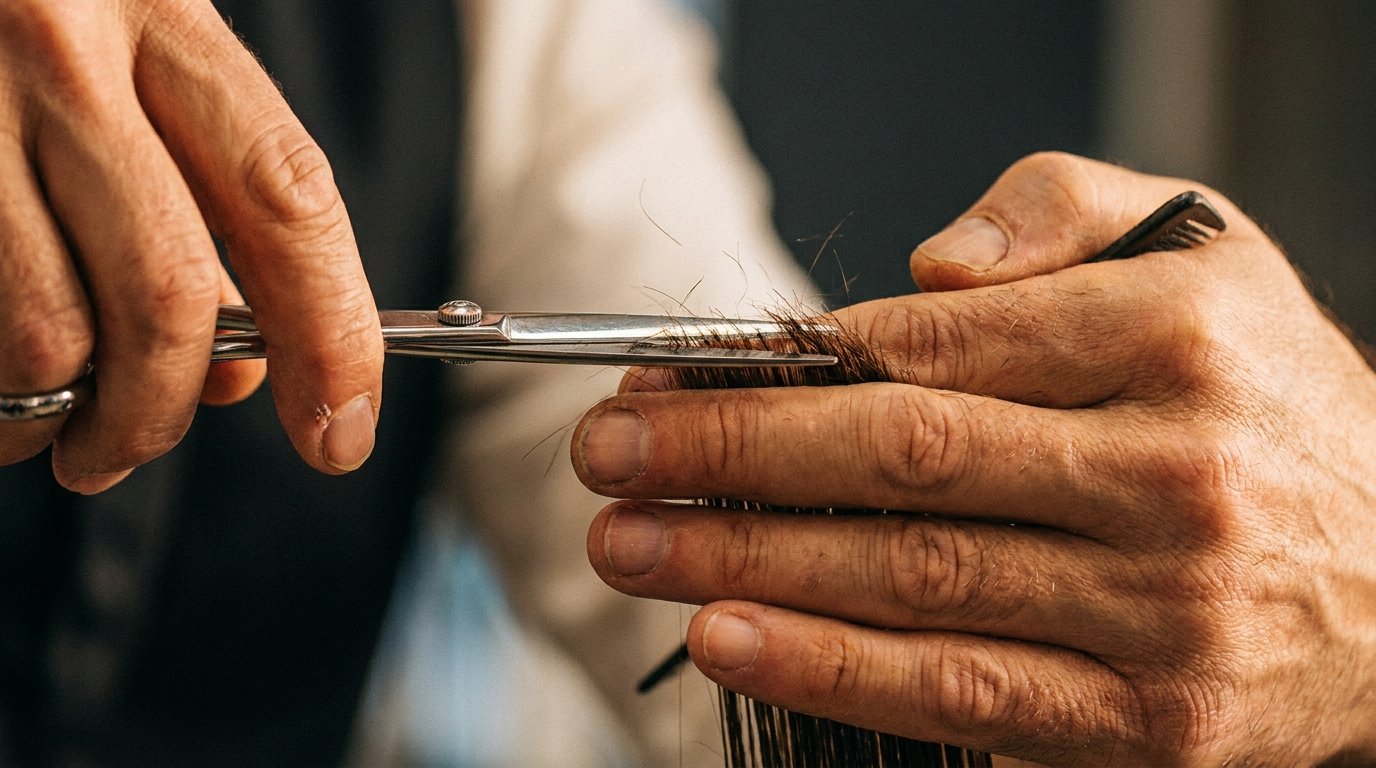
A model sits in profile under clean light. A stylist lifts a section, holds it at forty-five degrees, cuts, lets it fall. Another. Another. Then the cut to the finish: a graduated bob swinging into place, glossy and exact, right on the beat. It loops. Somebody watches it four times on the way to work.
By the fourth time, they understand it. They could name the elevation, find the guide, explain why the weight sits where it does.
They could not do it. Not on a woman with a double crown and fine hair at the nape. Not over the grown-out remains of someone else’s layers. Not for a client who says “just a trim” and means something else entirely.
Thirty seconds gives the illusion of access to mastery. It is only access to the result.
That illusion has been measured. In six experiments with more than 2,200 people, psychologists at the University of Chicago found that the more people watched someone perform a skill, from throwing darts to doing the moonwalk, the more confident they became that they could do it themselves. Their actual ability did not improve. Watching taught them the steps, not how the steps feel. When people who had watched a juggling video were handed the pins, their confidence dropped.
Watching is not doing. Hairdressing is entirely about doing.
The collision
In two decades, almost everything around the craft accelerated.
Information became instant: ask AI a question and the answer arrives in seconds, along with the feeling of having learned something. Feedback became instant: post a video at seven and by eight the views are climbing, the likes are in, the comments are arriving and the phone has buzzed a dozen times. Recognition became instant, or at least it looks that way: the stylist with a million views, the twenty-two-year-old with a waiting list. In a 2023 Morning Consult survey, 57% of Gen Z respondents said they would become an influencer if given the chance, and more than half believed people could easily make a career of it.
Hairdressing did not accelerate. Hair still grows in whorls and cowlicks. It still sits differently on a flat occipital bone than on a round one. Color still lifts warm on one client and stubborn on the next. Hands still learn the only way hands have ever learned: by doing the movement wrong, many times, until it starts to come out right.
Digital life runs on a short loop: action, result, feedback, reward. Hairdressing runs on a long one: lesson, demonstration, mannequin, mistake, correction, repetition, and only much later a result anyone else can see. One loop closes in minutes. The other can take months. That is the collision. Social media rewards visibility immediately. Hairdressing rewards competence slowly.
The title of this piece is a metaphor, not a forecast. Salons will not empty. Students will keep enrolling. The death we mean is quieter: the erosion of the culture of deep craft. Patience. Repetition. Tolerance of failure. The willingness to stay a beginner long enough to stop being one. A profession can have more students than ever and still be losing that.
The new learner
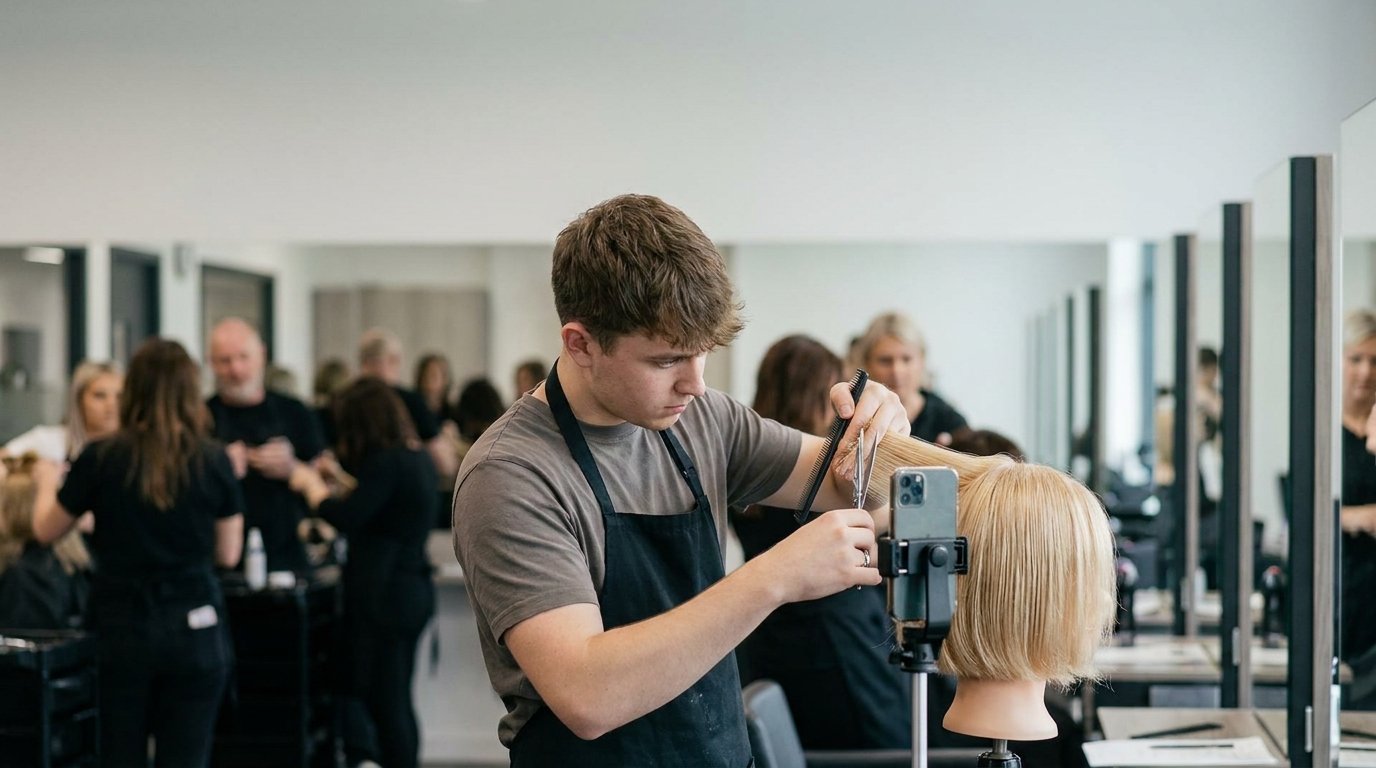
The young people walking into academies today are the first generation to have grown up entirely inside the short loop. They have lived their whole lives in a different feedback environment. Nearly half of American teenagers say they are online almost constantly, according to Pew Research Center. A decade earlier, it was 24%.
That environment runs on reward. When researchers analyzed more than a million posts from over 4,000 social media users, they found that posting followed the classic patterns of reward learning: people posted more after receiving more likes and less after receiving fewer. A follow-up experiment showed that the likes themselves changed behavior. The feed works like a training system. What it teaches is to expect frequent, quantified, social reward.
In adolescence, heavy use tracks with how young people develop. In a three-year brain-imaging study at the University of North Carolina, 12-year-olds who checked social media more than 15 times a day showed growing sensitivity to anticipated feedback from peers, while lighter users showed the opposite. The researchers suggest this may be an adaptation rather than damage. Either way, it is an adaptation to a world of constant social scoring.
Attention is shifting with it. A 2025 meta-analysis in Psychological Bulletin, pooling studies of nearly 100,000 people, found heavier short-form video use associated with poorer attention and weaker impulse control; the data are correlational and cannot say which comes first. Among adults at work, the UC Irvine researcher Gloria Mark has measured time on a single screen before switching falling from about two and a half minutes in 2004 to around 47 seconds. Today’s teenagers have never known the slower world.
None of this means young people are less capable. On the famous marshmallow test, children tested in the 2000s waited about two minutes longer, on average, than children in the 1960s. But Walter Mischel, the psychologist who created the test, noted what those results could not show: how willing children would be to wait amid today’s temptations.
That is the real question. Not capacity. Conditions. The new learner can wait. The new learner has simply grown up in a world that almost never asks them to. For most of their lives, the gap between effort and reward has been measured in minutes. Hairdressing is about to stretch it to months.
The third day
In conversations with The Hair Magazine, an educator at a British hairdressing academy described an advanced individual training program: seven sessions across roughly a week, for people who have already completed their basic training. Some students, the educator said, fade after the first few days. Some stop coming before the seventh session.
It is one educator’s observation. Anyone who has ever taught will recognize the shape of it.
The first day is exciting. The second day is interesting. The third day is where reality arrives.
By the third day, the novelty is gone. You understand exactly what the educator wants. You can see it. You can describe it. Your hands still cannot do it. You cut the same section and it comes out wrong in the same way. You are told, again, to drop your elbow. You do, and something else goes wrong.
You know more than you did on Monday. You feel worse.
That feeling is not evidence that learning has failed. It is often evidence that it has started. In a randomized study at Harvard, physics students taught through effortful, active methods learned more than students given polished lectures, and felt they had learned less. The students were misreading the effort itself as failure.
Now put that moment inside the short loop the new learner grew up in. A post gets its first reaction within minutes. The third day gets none: no likes, no views, no visible change in status. Only the same section, again. For someone whose experience of progress has always come with a notification attached, silence is very easy to mistake for failure. And the third day of real learning is almost entirely silent.
The part nobody posts
Mastery is boring before it becomes beautiful.
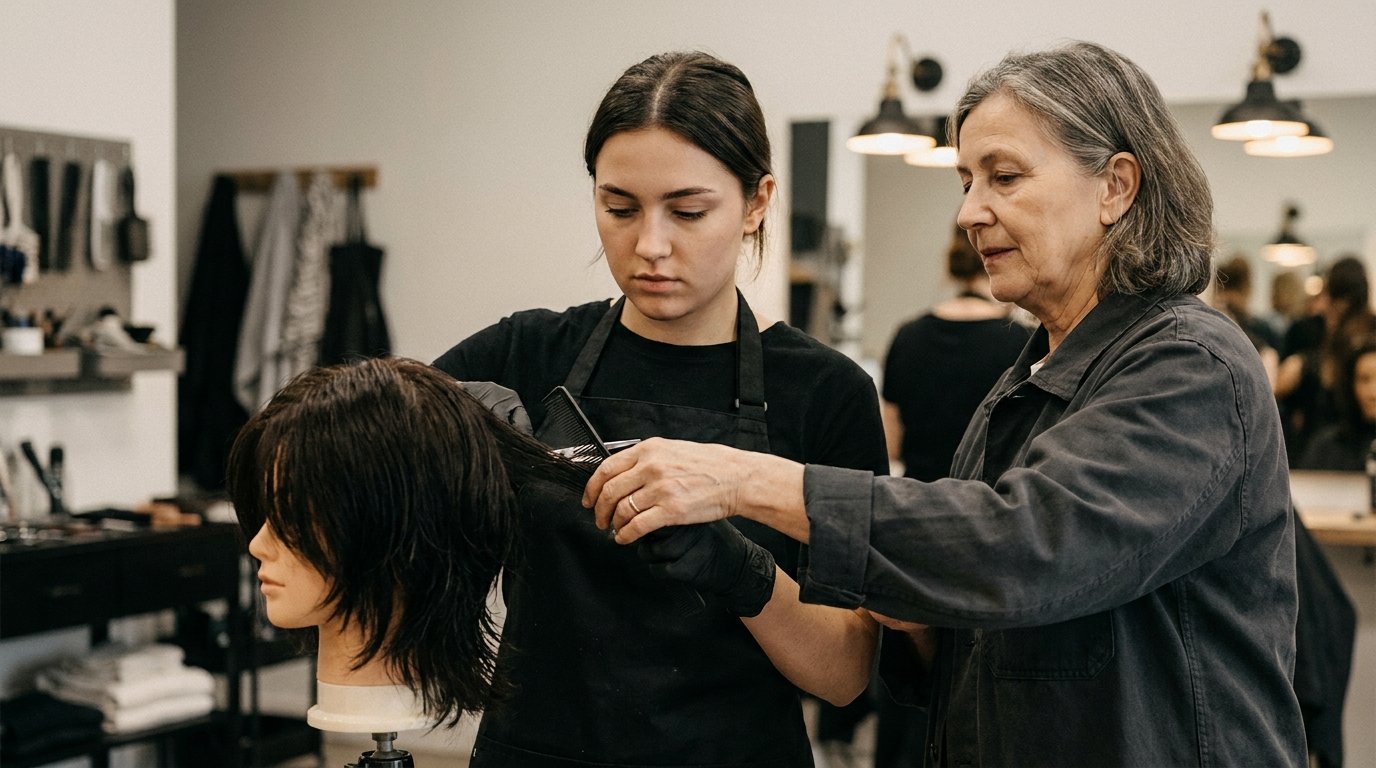
Shampooing is boring. Sweeping is boring. Standing behind a senior stylist all afternoon, passing foils, is boring. Cutting the same graduation on a training head for the sixth time on a Tuesday afternoon, and still not getting the line clean, is boring. Being corrected is boring. Being bad at something for months is worse than boring. It is quietly humiliating.
Count the loop. Lectures. Demonstrations. Weeks on a training head. Mistakes, corrections, the same movement again. No likes. No notifications. Nobody outside the room knows you exist.
Then, one day, a real client. Forty minutes of concentration you did not know you had. She looks in the mirror, turns her head, and says: “Thank you. I love it.”
For many beginners, that sentence is the first real reward the craft has ever given them. It may have taken weeks or months to arrive. A video can collect its first reaction in thirty minutes.
And the next client may not say it at all.
Because the real client is also where the craft turns hard.
A mannequin does not move. It does not arrive late. It does not have six years of box dye under the shade it swears is natural. It does not bring a reference photo of someone else’s hair, lit by someone else’s ring light. It does not look in the mirror at the end and say, quietly, “I don’t like it.”
A real client does.
That is where hairdressing becomes real: not in knowing the technique, but in making decisions when reality refuses to behave like the demonstration. The color lifts warmer than planned. The consultation went sideways and nobody noticed until the end. The fringe is a quarter-inch too short. A senior stylist steps in, in front of the client. Then the drive home, replaying it. Then the next day: another difficult head, another difficult colleague, aching feet, and the nagging sense that you are not improving fast enough.
And you come back tomorrow.
Hairdressing does not just require time. It requires frustration tolerance: the ability to absorb failure, criticism and boredom without concluding that something is wrong. The craft has always demanded this, and it has always lost people to it. In Australia, fewer than half of the hairdressing apprentices who started in 2018 went on to complete, according to the National Centre for Vocational Education Research, and completion was low two decades ago, too. What has changed is the background the difficulty now sits against. A culture that trains people to seek immediate positive feedback is poor preparation for a profession whose feedback, for years, is mostly correction.
There is one line worth drawing clearly. Some salons are genuinely unhealthy: exploitative, abusive, unpaid. Leaving them is not weakness. But “this environment is harming me” and “this is difficult, so it must be wrong for me” are different sentences, even if on a bad Tuesday they feel identical. Discomfort is not automatically evidence that something is wrong. In a craft, it is usually evidence that you are in the middle of it.
The illusion of progress
The internet shows the finished house. It rarely shows the foundation.
A young stylist scrolling at midnight sees beautiful hair, perfect light, perfect angles, flawless transformations and successful educators with enormous followings. They do not see the first five hundred bad haircuts. The years of assisting. The corrections, the difficult clients, the boring days, the money worries, the decade before anyone cared.
So they compare their beginning with somebody else’s finished product. They lose that comparison every time.
It produces a chain of quiet illusions. Watching feels like knowing. Knowing feels like competence. Visibility feels like achievement. Each step feels like progress. None of them is the same as standing behind a client and getting it right.
Motor-learning research points the same way. Watching skilled performers helps, especially combined with practice; on its own, a 2024 systematic review found, it produces far smaller gains than doing. In one experiment, people who watched both a novice and an expert attempt a task retained it better in the short term than people who watched only experts. Seeing errors made the right movement easier to recognize. A feed made entirely of flawless results strips out exactly what a beginner needs most: what getting it wrong looks like, and what getting better looks like.
Famous faster than excellent
Social media is not the enemy. It has given hairdressers real gifts.
At a 2023 advisory board meeting for a California community college’s cosmetology program, one stylist described leaving a high-end salon early, building a website and portfolio, renting a suite one day a week and growing her own clientele. Many of those clients, she said, had not always felt welcome in traditional salons. When the celebrity stylist Ted Gibson announced the closure of his Manhattan salon, he made a related point: social media meant a young hairdresser could build a clientele very quickly. If they were talented.
That condition is everything.
A person can now become famous faster than they can become excellent.
Popularity and competence are different measurements. One counts attention. The other is earned on clients’ heads, over years. Many of the most-followed hairdressers alive are also among the most accomplished. The danger is a profession that starts confusing the two measurements, visibility with authority, followers with experience, and a generation that learns to chase the first because it is the only one that moves.
The odds are also worse than the feed suggests. Goldman Sachs has estimated that only about 4% of creators earn more than $100,000 a year. The winners are real. They are also the only ones you see.
Instant answers
Artificial intelligence is the same shift, accelerated.
Ask a question, get an answer in seconds, feel that you have made progress: it is the short loop in its purest form. Used well, it is a remarkable tutor. It can explain color theory, unpack the structure of a haircut, suggest consultation questions and troubleshoot lightener that stalled, patiently, at 2 a.m. But it also makes the feeling of competence cheaper than ever. In a field experiment published in the Proceedings of the National Academy of Sciences in 2025, nearly 1,000 high school math students practiced with GPT-4. Those using a standard chatbot scored 48% higher on practice problems. When the tool was taken away, they did 17% worse on the exam than students who had never used it. A version designed to guide rather than answer largely avoided the damage.
Access to answers is not the ability to perform without them. AI can accelerate access to knowledge. It cannot automatically accelerate embodied skill, judgment or experience. No model can do the thousandth repetition that teaches your fingers how much tension fine hair will take.
The real danger to the future of hairdressing
The profession does not need fewer students. It needs people willing to remain students long enough to become professionals.
The pressure against that is not only cultural. The economics push the same way. At that California meeting, a Bay Area salon owner described an assisting program he completed that lasted more than three years. His own salon now offers about one. People did not want three-year programs, he said, and Bay Area living costs made them unrealistic. In England, the minimum length of an apprenticeship was cut from twelve months to eight in 2025, and hairdressing and barbering apprenticeship starts fell from 16,080 in 2015/16 to 5,250 in 2024/25, a decline industry bodies tie to funding, apprentice wages and the rise of self-employment. Long training is expensive. Poorly paid training is harder to justify than ever. Salons need juniors productive fast.
So the squeeze comes from two directions. A culture of instant reward makes the slow years harder to tolerate. An economy with less and less patience makes them harder to pay for. Every force points toward shorter, faster pathways, except the craft itself, which still takes as long as it takes.
That is what a slow death looks like. Not empty salons. Full ones, staffed by fewer people who have crossed the long middle and know what lies on the other side. And clients who can no longer tell the difference, because the only measurement they can see is the one that moves.
Thirty seconds
Somewhere right now, someone is watching that bob swing into place for the fourth time. It loops, glossy and exact, and it looks easy.
The person who cut it may have spent years becoming able to make it look that way. The early mornings. The corrections. The clients who never came back. The Tuesday afternoons nobody filmed.
Thirty seconds to watch. Years to master.
Maybe the problem isn’t that young people cannot learn. Maybe they have grown up with a loop between effort and reward measured in minutes, and are walking into a craft that measures it in months and years.
Hairdressing has no way to make that part faster.
The only question is whether enough people will still be willing to spend the years.