


The Gate Is Open: How the Internet Broke the Academy's Monopoly on Professional Authority in Hairdressing
On August 6, 2025, a barber school opened inside Valley State Prison in Chowchilla, California. It carries the name of Victor Fontanez, the barber known online as VicBlends, who counts roughly 25 million followers across platforms and who put close to $100,000 of his own money into the build. It is the first accredited barber school inside a California men’s prison. Graduates can leave with a state license.
Then comes the detail that should stop every academy owner in this industry mid-sentence.
When Fontanez needed someone to actually teach in the room he had built, he did not hire a creator. He hired Roberto Martinez, a barber who has been cutting hair for more than fifty years. “I had my barber’s license before I had my high school graduation,” Martinez told reporters at the opening.
Read that sequence carefully, because the order tells you everything. The audience came first. The money followed the audience. The accreditation followed the money. The institution followed the accreditation. And only at the very end, once the room existed, did anyone need a man with fifty years of accumulated craft.
For sixty years, that sequence ran the other way.
The Hair Magazine’s position
We are going to state this plainly, because the industry has been circling it for a decade without saying it.
The internet has already broken the academy’s monopoly on professional authority in hairdressing. Not weakened it. Not challenged it. Broken it. The gatekeeping system that once determined which hairstylists mattered, which techniques were worth learning, and which names carried weight no longer controls the gate.
This is not an argument that Vidal Sassoon, Sassoon Academy, Pivot Point, Saco or any other historic institution was unimportant. The opposite is true, and the first half of this article is devoted to proving how important they were. It is also not an argument that creator-educators are better teachers. Some are excellent. Some are not. Attention is not competence, popularity is not mastery, and a follower count has never cut anybody’s hair.
Our position is structural, not evaluative. A professional in this industry no longer needs an institution to become an authority. They can become the institution themselves. That has never been true before, and the profession has not yet reckoned with what it means.
What the academy actually was
To understand what has been lost, you have to understand what was built, and how deliberately.
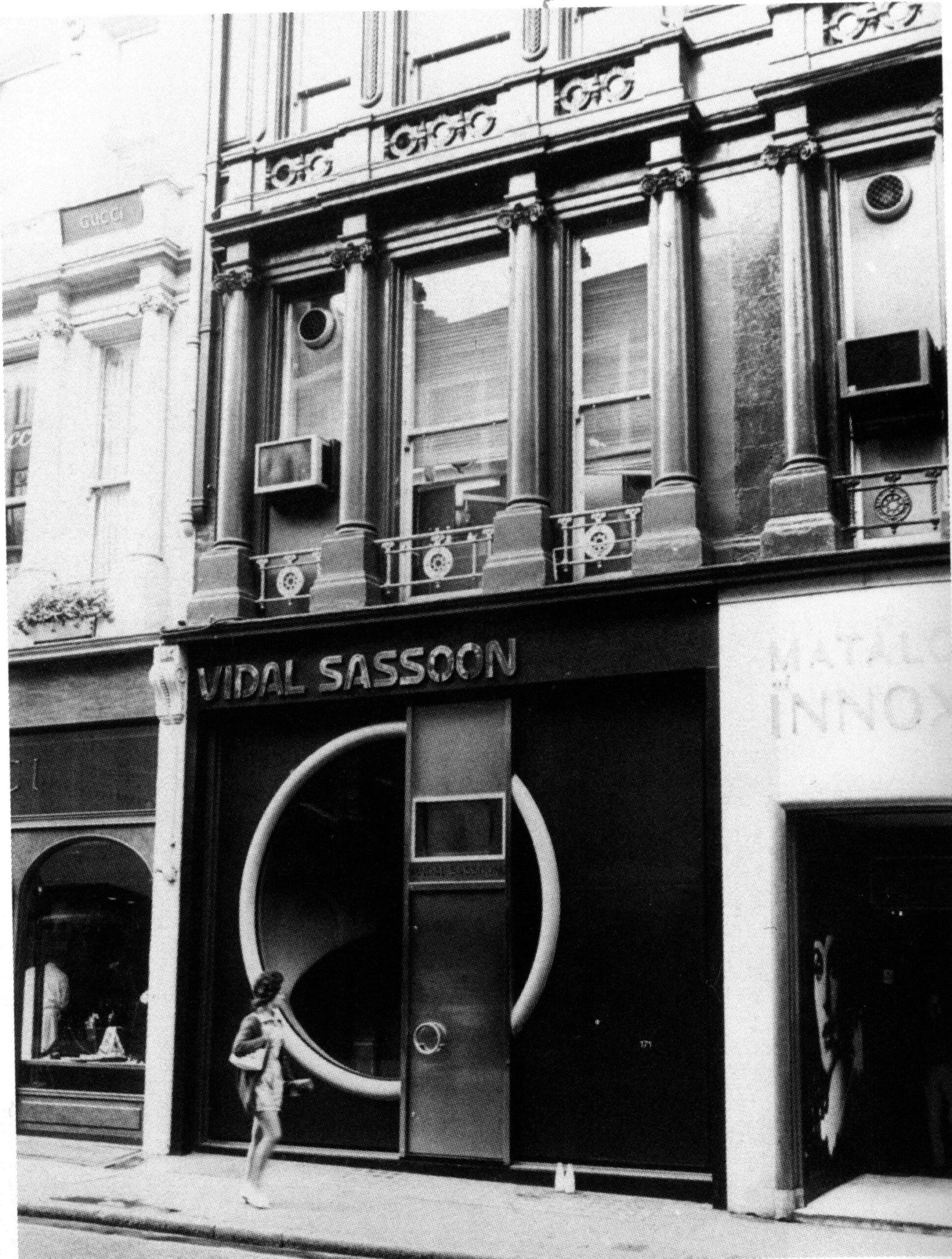
Vidal Sassoon opened his first salon at 108 Bond Street in 1954, into a market where women returned weekly to have hair teased, rolled and lacquered into a shape it would never hold on its own. His argument was structural rather than decorative. If the cut is right, nothing needs to hold it. Hair was “material in motion.” He named the Bauhaus as his source and described the ambition as getting rid of the superfluous and paring it back to basics.
Mary Quant said he was the first hairdresser to cut hair as though it were a fabric. Issey Miyake traveled to Bond Street simply to stand and watch the cutting, staying a couple of hours at a time. The Five Point Cut is the shape that entered the cultural record, though even its date resists pinning down: Sassoon’s own academy dates it to 1963, NPR’s obituary to 1957, and Sassoon himself said it took him nine years to arrive at.
The date matters less than what the philosophy made possible. A knack cannot be taught at scale. A system can. Once the knowledge became explicit — elevation, graduation, the head read as architecture — it could be written down, sequenced and taught to strangers in a room. The academies followed in the late 1960s, first in New York, then London and San Francisco, according to the Scribner Encyclopedia of American Lives.
What that produced was not simply a school. It was a mechanism for manufacturing professional authority, and it was extraordinarily effective.
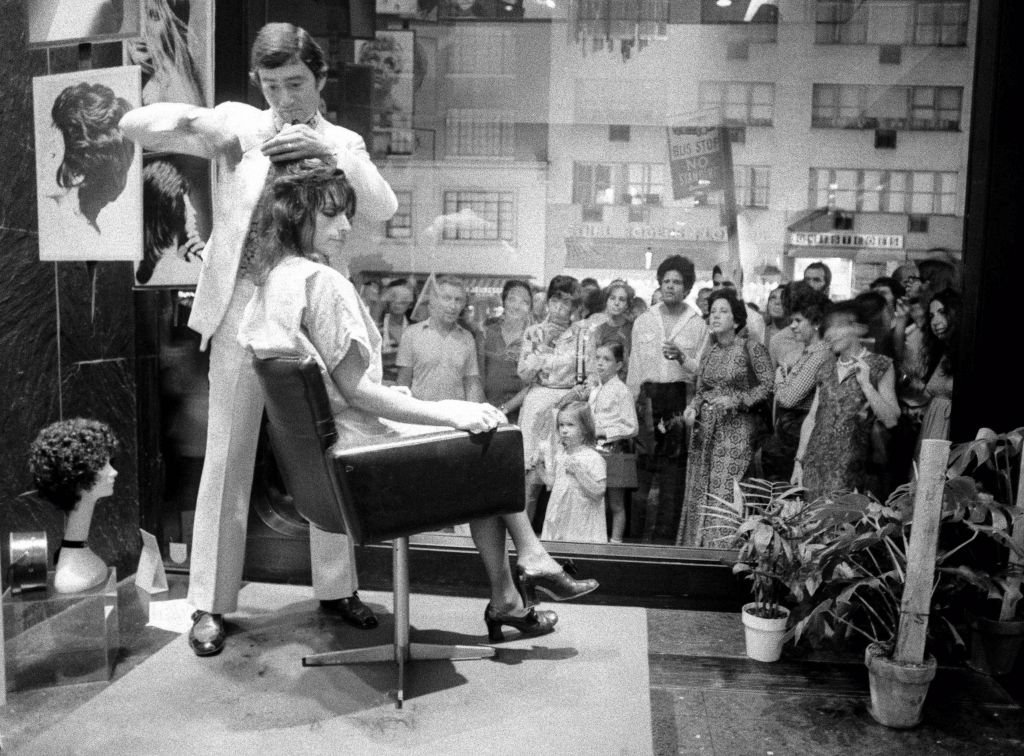
The academy decided what good work looked like. It decided which techniques were worth transmitting and in what order. It decided who was fit to teach, and therefore who became an educator. Trade magazines covered the collections the academies produced. Competitions rewarded the standards the academies had set. Stages were offered to the people the academies had already elevated. A stylist who had trained at a recognized house carried a passport; a stylist who had not needed some other explanation for themselves.
It was never one bloodline
The romantic version of that history has everything descending from one man. The record is less obliging, and the correction matters, because it shows how broad the gatekeeping structure really was.
In 1962 — a year before the Five Point Cut — a Dutch competition hairdresser named Leo Passage opened Pivot Point Beauty School in Chicago with five students. He cited the Bauhaus too. He published A Scientific Approach to Hair Design in 1965, then did something Sassoon never did: he licensed his curriculum to other institutions through a member-school network, letting approved schools display an accreditation mark. Reported scale varies with the source and the metric — Pivot Point’s method has been described as reaching 300 US member schools across 80 countries, and elsewhere as taught in 2,000 schools across more than 70 — but the direction is not in dispute. Passage’s pedagogy reached further into formal education than Sassoon’s ever did.
Two men, two countries, overlapping years, reading the same German design school. That is convergence, not inheritance.
The most revealing evidence comes from a competitor. Michael Gordon founded Bumble and bumble and later originated the 2010 documentary on Sassoon’s life. He told Modern Salon that he never trained at Sassoon and did not meet him until his mid-forties, but held Sassoon “as a benchmark, a model” while building his own company.
Influence without apprenticeship. Reputation traveling faster than technique, shaping a rival house it never touched. That mechanism is not new. Social media simply industrialized it and handed the controls to anyone with a phone.
Nobody was ever officially in charge
There is a structural fact underneath all of this that the profession rarely says out loud, and it explains why the academies mattered as much as they did.
In the United Kingdom, hairdressing is not a regulated profession. The House of Commons Library states it plainly: no general licensing requirement, no statutory requirement to hold qualifications. The Hairdressers (Registration) Act 1964 created a register, but registration is voluntary, the Hair Council receives no government funding, and it has no legal power to act on behalf of consumers. The Library’s own estimate is that around 10 percent of British hairdressers are registered.
The state never conferred authority in British hairdressing. The academies filled a vacuum — and because they filled it convincingly for sixty years, almost nobody noticed it was a vacuum, or that a vacuum can be refilled by whoever arrives next.
American practice runs differently, with state boards, mandatory licensure and hour requirements. That is precisely why the accreditation of Fontanez’s prison academy took four years to secure and was worth securing. But in both markets, the layer of reputation sitting above the license was always decided informally, by peers and editors and networks. That layer is what has now changed hands.
The order reversed
The new route runs backwards through the old one. Skill and content, then social media, then audience, then visibility, then influence, then commercial opportunity, then teaching. Authority arrives at the end, granted by the audience rather than by the institution.
Anyone who has watched the music industry over the past fifteen years already recognizes this. A singer once needed a producer, a manager or a label to build them an audience, book them rooms and turn them into a career. Now a singer uploads themselves to TikTok, builds millions of followers alone, and the labels, promoters and television bookers come to them. The industry did not disappear. It stopped being the entrance.
Hairdressing is midway through the same transition. An educator no longer needs the profession to grant them a stage. They can build the audience first, and the stage arrives afterward — along with the brand partnership, the product line and eventually the academy.
This did not begin with short-form video, and the industry consistently gets the timeline wrong. Behindthechair.com launched in 2000, before YouTube existed. MyHairdressers was established in September 2007 as a paid subscription service delivering weekly step-by-step tutorials with accompanying PDFs; it now lists more than 500 videos and 71 instructors. Structured professional online education is nearly two decades old. What the free platforms changed was not availability. It was who commanded attention.

By the mid-2010s the commercial logic had flipped in public. When Henkel launched Guy Tang’s #mydentity color line, its general manager Robert Schaeffler described it to Modern Salon as “a line born online and fueled by social media, a brand for the new generation of stylists out there who crave a line built around their own online community.” A global manufacturer had concluded that one colorist’s audience was a more reliable route to working stylists than its own distribution network. That is a gatekeeper admitting the gate had moved.
Then the pandemic forced every institution onto the same ground at once. Sassoon built and launched SassoonOnline while its academies stood closed. It now carries more than 240 courses with a free tier and a paid upgrade. The house that once required you to fly to London will now teach you for nothing, because in a market for attention the first lesson has to be free.
What fifteen years on this floor looks like
Here is where the shift stops being theoretical.
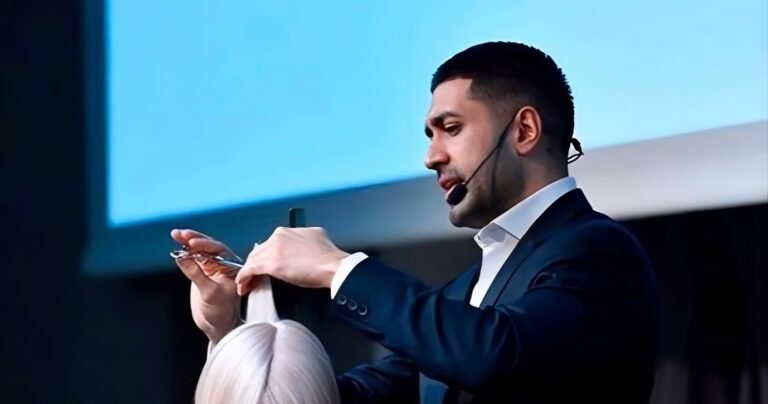
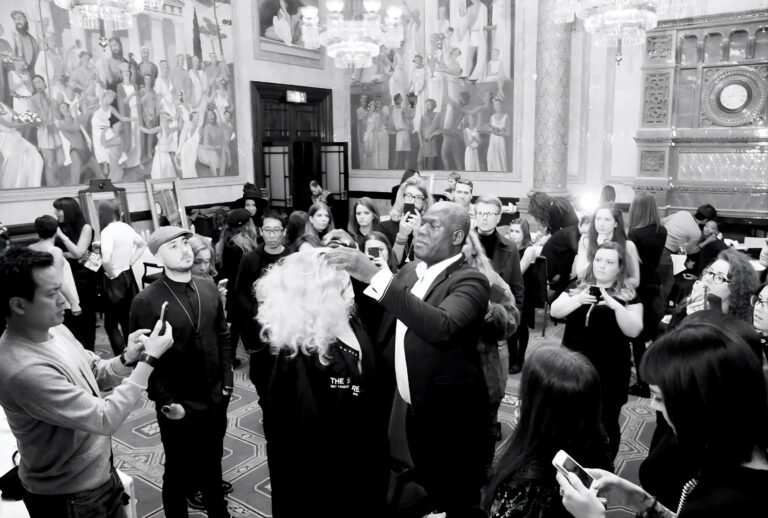
Anyone who has spent fifteen years in professional hairdressing has watched trade shows change in a way that would have been difficult to imagine in the academy era. You can stand in a hall today and watch several hundred working stylists pack a stage for an educator whose name means nothing to you — an educator who has never been through a recognized house, never appeared in the trade press you grew up reading, and never been elevated by anybody’s creative team. They are there because two million people already know exactly who that person is.
At the same event, in the same hour, a stylist with three decades behind the chair and an impeccable academy background can draw a respectful, modest crowd.
That comparison does not prove which of them is the better teacher. It proves something more consequential, and the industry keeps flinching from it: the mechanisms that create attention have changed, and authority follows attention.It always has. The academies understood this perfectly well when they were the ones producing the collections that filled the magazines.
Now put the choice to a real person. A young stylist has saved several thousand pounds and can spend it once. Option one is London and a course at the Vidal Sassoon Academy, with the diploma and sixty years of heritage attached. Option two is a flight to a major event and a hands-on class with a contemporary educator whose videos have millions of views and whose sessions sell out.
Ask any salon owner which way that decision is trending. Twenty years ago the question would have been close to meaningless. Today it is a live commercial reality that academies are pricing for.
And this is the part that should worry the institutions most. The younger generation is not rejecting the old houses. Rejection would at least be a relationship. They are simply not needing them, which is quieter and much harder to reverse.
Attention is not competence
None of this means the new system is better. We are not arguing that it is. We are arguing that it exists, that it is now the dominant route, and that it carries real costs the profession is not tracking.
The most honest testimony on that point comes from someone with a commercial interest in the opposite conclusion. Aryn Detres founded The Left Brain Group, an agency representing independent hair educators. Asked whether credentials still matter, she said she has “a lot more trust and belief in someone who comes from a very strong educational background. But if you have a successful Instagram following of people who like your aesthetic, it doesn’t necessarily matter.”
She went further: “Anyone can be an educator now, whether you have 20 years behind the chair or you’re fresh out of beauty school. It depends on how you market yourself.”
That is a participant in the new system describing its central weakness. An academy had to establish credibility before students would come. A creator can establish reach first and credibility afterward, or never.
The evidence for what gets lost in that trade is specific. In 2018, Michael Kardas and Ed O’Brien published six experiments in Psychological Science, with 2,225 participants, showing that repeatedly watching someone perform a skill inflates confidence without improving performance. Participants who watched a darts demonstration twenty times predicted higher scores, reported having learned more technique, and scored no better than those who watched once. Reading instructions produced no such inflation. Video specifically did. Those were lab tasks performed by the general public, not haircuts performed by professionals, but the mechanism is uncomfortably relevant to a craft involving shears and oxidative chemistry.
Mandy McCullough, a Redken artist and Sam Villa ambassador, put it to American Salon with less patience: “If you’re about to go in for a surgery and ask your doctor how many times they’ve performed the procedure, and their response is, don’t worry, I watched a video on TikTok, how confident would you be?”
Peer-reviewed work supports her instinct. A 2018 study in Vocations and Learning examining feedback in hairdressing classrooms found the knowledge to be embodied and materially situated, with correction produced jointly, in real time, between teacher and student. That is the one thing a feed structurally cannot do.
And yet the numbers are what they are. MyHairdressers, a dedicated professional education platform with 71 instructors, has around 51,000 YouTube subscribers. One barber has roughly 25 million followers. Attention has moved decisively. Correction has not moved at all. The gap between those two sentences is where the next generation is being formed.
The contradiction at the center
The most interesting thing about the new system is how many of its stars were built by the old one.
Richard Ashforth joined Sassoon in 1987 and stayed roughly eighteen years, rising to creative director within its school system. In the mid-2000s he left to co-found Saco, which grew into salons and academies across three continents, and launched NOISE as a deliberately raw, anti-corporate alternative to the industry’s glossy show circuit. He built a competitor to the house that made him, then built an online education arm to go with it. In April 2025 he returned to Sassoon as International Creative Director, working alongside Mark Hayes, promoted to Senior International Creative Director. Their first collection together, LIBERTINE, arrived in March 2026.
Guy Tang is a licensed colorist. Fontanez attended a licensed barber school before anyone had heard of him. Almost none of the largest online authorities in hair are self-taught.
The institutions are still producing the talent. They are no longer capturing the credit. That is a far more dangerous position than being outcompeted, because it looks like health right up until the moment it doesn’t.
The institutions have noticed. In January 2026 L’Oréal opened a 13,097-square-foot academy at Hudson Yards in New York, absorbing the old Redken Exchange and listing influencer partner-led classes on the same timetable as its certification pathways. Behindthechair.com now runs a media outlet, an education platform, an awards program and a paid influencer roster simultaneously. The old gatekeepers are buying access to the new gate, which is itself an admission of where the gate now stands.
Heritage authority is not current authority
Which brings us to Sassoon, and to a distinction this profession needs and does not yet have.
Educational authority is being the place a professional goes to learn something they cannot learn elsewhere. Heritage authority is being a name that confers status because of what it once was, who passed through it and what it changed. Those were the same thing for sixty years. They have come apart.
The evidence on Sassoon runs in both directions, and an honest article reports both. UK operations entered administration on May 6, 2021, and were bought out by a private investor group the same day, retaining all 176 UK employees. The brand is now split across corporate territories: the academies operate under license from Coty, while Henkel acquired the Greater China consumer business from Procter & Gamble in February 2024. The North American footprint has contracted and relocated — 2014 marketing named seven academy cities, including San Francisco, Miami, Chicago and Seattle; the current team directory lists five in North America, and none of those four appear.
Set against that: twelve academy locations worldwide. An Independent Schools Inspectorate inspection the company says it exceeded. Designation as the Fellowship for British Hairdressing’s third Centre of Excellence. The House of Sassoon concept on Greek Street in Soho, announced in 2023, combining salon, academy, studio, members club and an ambassador program. A serious digital platform. New creative leadership and new work.
This is not an institution in decline. It is an institution doing almost everything right and still watching the ground move underneath it, which is a much more interesting problem.
The most telling product in the catalogue is the four-day Heritage Course, teaching the shapes of the 1960s and 70s on mannequin heads. It is a smart, profitable decision. It is also a signal. There is a version of studying at a legendary academy that increasingly resembles drinking a rare vintage: valued partly for its scarcity and its story, something a professional genuinely wants to experience once and is proud to have on their record. That is real value, and no one should be dismissive of it. It is simply not the same as being the first place a stylist goes when they need to learn a technique on Monday morning.
Sassoon is not disappearing. Its monopoly over professional aspiration already has.
The question the industry keeps avoiding
Twenty years ago, a serious stylist who did not know Sassoon’s work could reasonably be called professionally uninformed. The gap was in the individual, and everybody agreed on that.
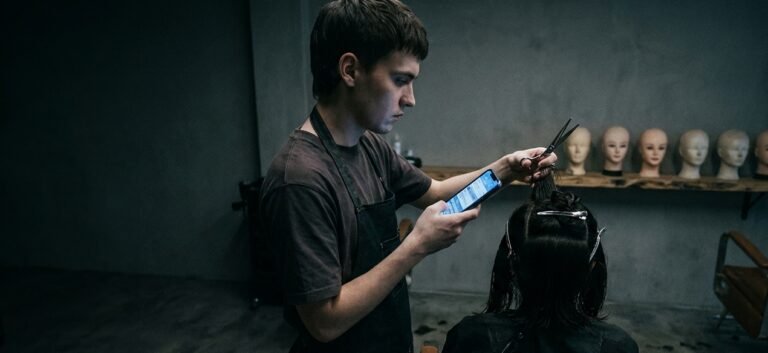
Today a stylist can enter this profession through an entirely different information ecosystem: hours a day of educators on TikTok and Instagram, three paid courses a year, a trade show ticket bought specifically to see a creator, and no encounter with the historic houses at any point.
So here is the question, and we are putting it as sharply as we can. If a generation of hairstylists knows forty contemporary educators and not the name Vidal Sassoon, at what point does that stop being a failure of the hairstylist and start being a verdict on the institution’s place in the culture of the profession?
No survey has measured this. No trade study, no academic work, nothing — which is exactly why we are writing it. This transformation has been happening in plain sight for a decade and the industry has not produced a serious account of it. Waiting for someone else to formalize the obvious is not neutrality. It is just delay.
One adjacent trend makes the pipeline question concrete. Analysis of Department for Education figures by the Guardian found hairdressing apprenticeship enrollments in England fell from 13,180 in 2015 to 4,160 in 2023, with completions down from 8,660 to 1,520. Modeling by CBI Economics for the British Hair Consortium forecast zero new UK hair and beauty apprenticeship starts by 2027. The causes named are fiscal, not digital: the tax advantage of self-employed models, VAT on labor, and the fact that self-employed practitioners do not take apprentices.
Social media did not cause that. But the consequence lands in the same place. Fewer stylists are entering the profession through any institution at all — and an institution that is no longer where you are formed has a weakening claim to be where you are validated.
What comes next
The future is not old versus new. It is a hybrid, and the hybrid is already operating.
The creator brings attention. The institution brings structure, sequencing and a credential someone else recognizes. The veteran practitioner brings the thing that cannot be shortcut: thousands of heads and the judgment that accumulates behind them. The algorithm distributes all of it to an audience no institution owns.
What has changed is not whether the academy has value. It plainly does. What has changed is the power relationship between the parts.
Go back to Chowchilla. A man with 25 million followers built the room, paid for the chairs, spent four years getting the state to accredit it, and only then went looking for a barber with fifty years behind the chair to teach inside it.
The academy used to create the authority.
Now the authority creates the academy.
Sources & Further Reading
House of Commons Library — Regulation of Hairdressers
Read the briefingKardas, M. & O’Brien, E. (2018) — Easier Seen Than Done: Merely Watching Others Perform Can Foster an Illusion of Skill Acquisition — Psychological Science
Read the research articleSassoon Academy — Vidal Sassoon Heritage
Explore the Sassoon heritagePivot Point International — History Timeline
Explore the Pivot Point history